


 Englisch
 Spanisch
 Portugiesisch
 Französisch
 Italienisch
 Japanisch
Dokumentation & Benutzerhandbücher
Lernen Sie die Grundlagen, oder verfeinern Sie Ihre Fähigkeiten mit Tutorials, die Sie inspirieren werden.
Zuletzt aktualisiert am 23. 4. 2026 von Kornel Mazur
Cross-Checks – Robust Testing – Overview
Inhalt der Seite
Cross-Checks – Automated Strategy Robustness Tests
A key challenge in algorithmic strategy development is Überanpassung (also known as curve-fitting), where a strategy is too closely tailored to historical data and fails to generalize to future, unseen market conditions. Cross-checks in StrategyQuant X are designed to address this challenge by applying automated robustness testing.
What is Robustness?
Robustheit refers to a strategy's ability to perform consistently across varying market conditions and data sets. A robust strategy should:
- Perform well on unseen (Out of Sample) data, assuming market behavior remains consistent.
- Be tolerant to minor variations in input parameters (e.g., indicator periods, trade entry/exit settings).
- Handle market anomalies, such as changes in spread, slippage, or missing trades, without significant performance degradation.
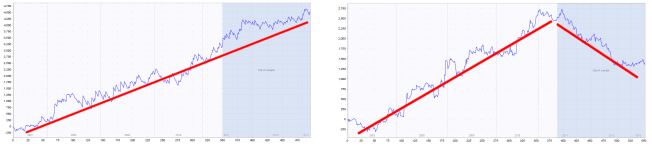
A basic robustness validation is testing strategy performance on Out of Sample data, especially after genetic evolution, which is performed only on the In Sample portion.
Why Use Cross-Checks?
Cross-checks help eliminate overfitted strategies by simulating alternate market conditions, modifying input variables, or retesting under different assumptions. They are applied after a strategy passes its initial generation and filtering phase.
Cross-checks can include:
- Precision retesting
- What If Simulations
- Monte-Carlo-Simulationen
- Multi-market retesting
- Walk-Forward Analysis
- Walk-Forward-Matrix
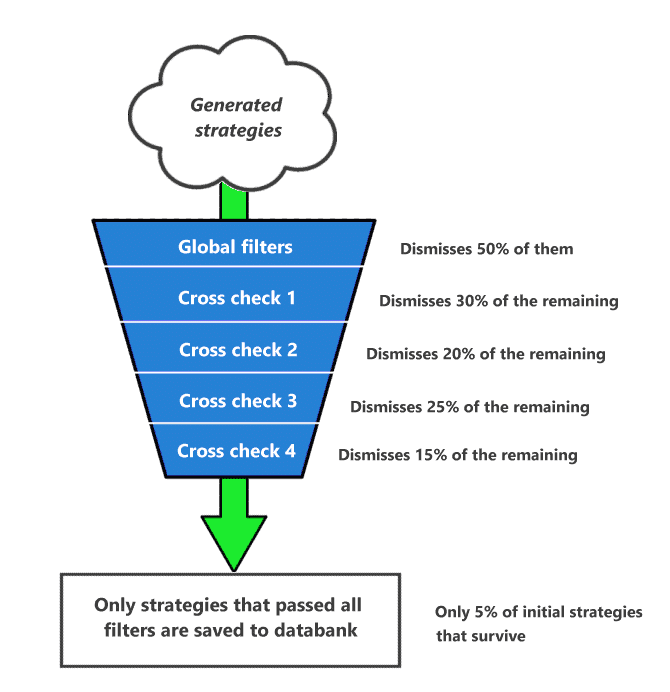
Strategies that fail a cross-check can be automatically excluded, allowing only robust candidates to proceed through the development funnel.
How Cross-Checks Work
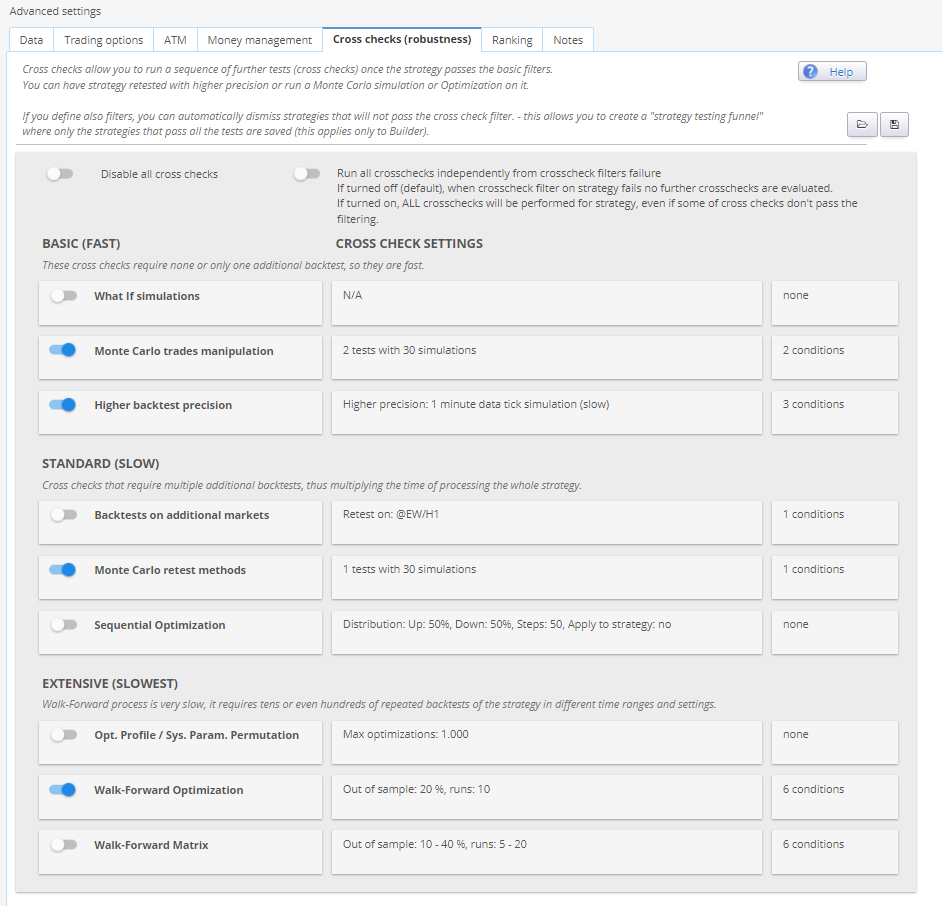
Cross-checks can be used during both Strategiebildung und post-analysis in the Retester. Within a build process, you can configure multiple cross-checks, arranged in order of increasing complexity. If a strategy fails at any stage, it is immediately discarded, and no further checks are performed on it.
Cross-check types are typically categorized by complexity and computational cost:
- Grundlegend
- Standard
- Extensive
Important Note: Cross-checks can significantly increase processing time. A strategy generated in 0.2 seconds might require 10–200 seconds when subjected to cross-checks, depending on the complexity and number of simulations.
Example Usage: Robustness Filtering Funnel
Below is an example of a multi-layer cross-check process used to ensure strategy reliability:
- Initial Strategy Generation
- Strategy is generated and backtested with basic precision settings.
- Global Filtering
- Strategy is discarded if it fails core metrics (e.g., Net Profit < $1,000 or insufficient trade count).
- Cross-Check: Retest with Higher Precision
- Retesting at minute or real-tick precision to validate initial results.
- Cross-Check: Monte Carlo – Trade Manipulation
- Simulates alternate equity curves by rearranging or modifying trades to detect randomness.
- Cross-Check: Retest on Additional Markets
- Verifies strategy profitability on different symbols or timeframes.
- Optional Cross-Check: Monte Carlo – Retest Methods
- Conducts hundreds of independent backtests with minor variations (e.g., changes in slippage, spreads, or indicator parameters).
- If 100 simulations are run, each taking 0.2 seconds, this step alone may require 20 seconds per strategy.
- Final Outcome
- Only strategies that pass all selected cross-checks are saved to the Datenbank.
This layered approach helps ensure strategies are not only profitable under test conditions but also statistically reliable and resilient.
Additional Notes
- Cross-checks are not mandatory during the build phase. You can choose to apply them later in the Wiederholungsprüfer, especially for time-intensive evaluations.
- Cross-check filters and thresholds can be fully customized based on your performance criteria and computational capacity.
War dieser Artikel hilfreich? Der Artikel war nützlich Der Artikel war nicht nützlich
Inhalt der Seite