


 Inglês
 Espanhol
 Francês
 Italiano
 Alemão
 Japonês
Documentação e Guias do Usuário
Aprenda o básico, ou aperfeiçoe suas habilidades com tutoriais projetados para inspirar.
Última atualização em 23 de abril de 2026 por Kornel Mazur
Administração do dinheiro
Conteúdo da página
Settings → Money Management
Money management (also known as position sizing) determines the number of lots, shares, or units traded per position. StrategyQuant offers a variety of flexible and extensible money management models to suit different markets and trading styles.
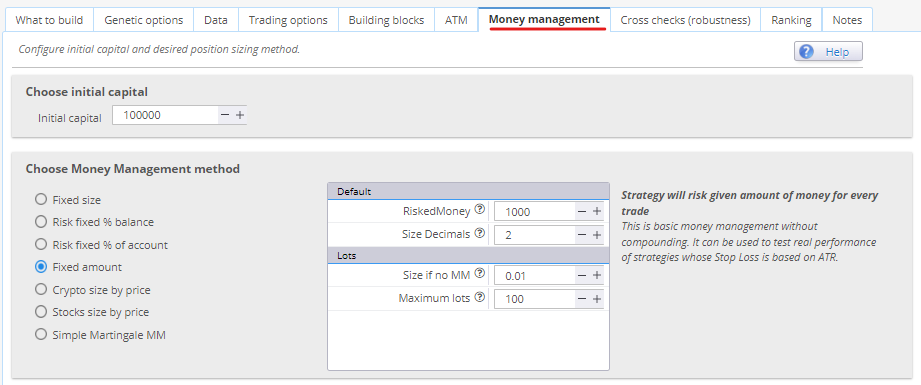
Money Management Methods
Fixed Size
- Trades a constant number of lots per position.
- Recommended during strategy generation for evaluating strategy behavior independent of compounding effects.
Valor fixo
- Risks a fixed dollar amount per trade.
- Useful when working with volatility-based SL (e.g., ATR) or when comparing strategies with different SL configurations.
Risk Fixed % of Account
- Risks a specified percentage of account equity per trade.
- Dynamic sizing based on real-time equity, including floating P/L.
- Recommended for real trading.
- Typical setting: 1–5% risk per trade.
Risk Fixed % of Balance
- Similar to the above but uses account balance (excluding open positions).
- Reflects only closed trade P/L, offering more stability in sizing under high volatility.
Stocks Size by Price
- Designed for stock trading.
- Calculates position size based on stock price and available balance.
Crypto Size by Price
- Tailored for cryptocurrencies.
- Computes size as Balance / Asset Price.
- Requires precise decimal configuration for rounding (due to varying precision in crypto markets).
Simple Martingale Money Management
- Increases trade size after losses using a Martingale progression.
- Risky approach; suitable for specific strategies with well-defined reversion behavior.
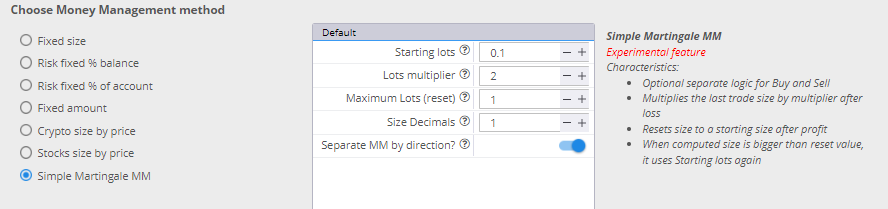
Choose the model that matches your trading platform and strategy risk profile. All money management configurations are compatible with real-time execution on supported trading platforms.
Este artigo foi útil? O artigo foi útil O artigo não foi útil
Acessar para comentar
0 Comentários
mais antigos
Conteúdo da página