


 Anglais
 Espagnol
 Portugais
 Italien
 Allemand
 Japonais
Documentation et guides de l'utilisateur
Apprenez les bases ou affinez vos compétences grâce à des tutoriels conçus pour vous inspirer.
Dernière mise à jour le 25 août 2025 par Kornel Mazur
Comment fonctionne StrategyQuant X ?
Contenu des pages
StrategyQuant X employs a two-phase process for creating and refining algorithmic trading strategies: Random Strategy Generation et L'évolution génétique. Both processes leverage a wide array of technical indicators, order types, and customizable logic structures to generate and optimize strategies without the need for programming knowledge.
Random Strategy Generation
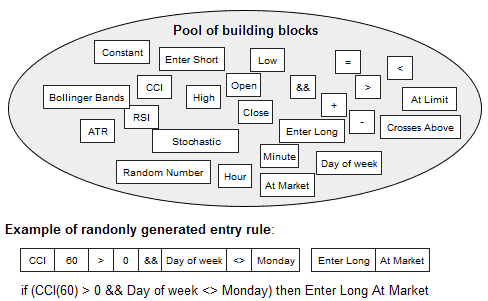
At the core of StrategyQuant X is a randomized strategy generation engine. In this phase, trading strategies are constructed by randomly combining predefined building blocks, including:
- Technical indicators and oscillators (e.g., CCI, RSI, Stochastic, Momentum)
- Price patterns
- Time-based conditions (e.g., time of day, day of week)
- Entry and exit order types (e.g., market orders, limit orders, fixed profit targets, exit after a number of bars)
These components are assembled using logical and comparison operators (e.g., AND, OR, >, <) to form the rules for trade entry and exit.
StrategyQuant X can generate trillions of unique strategy combinations, thanks to the vast number of permutations available through its building block library.
Each strategy is built randomly, with embedded constraints ensuring logical consistency (e.g., preventing comparisons between incompatible data types such as price and time). While not all randomly generated strategies are profitable, the system can produce and evaluate thousands of strategies per hour, increasing the likelihood of identifying viable candidates.
Genetic Evolution (Genetic Algorithm)
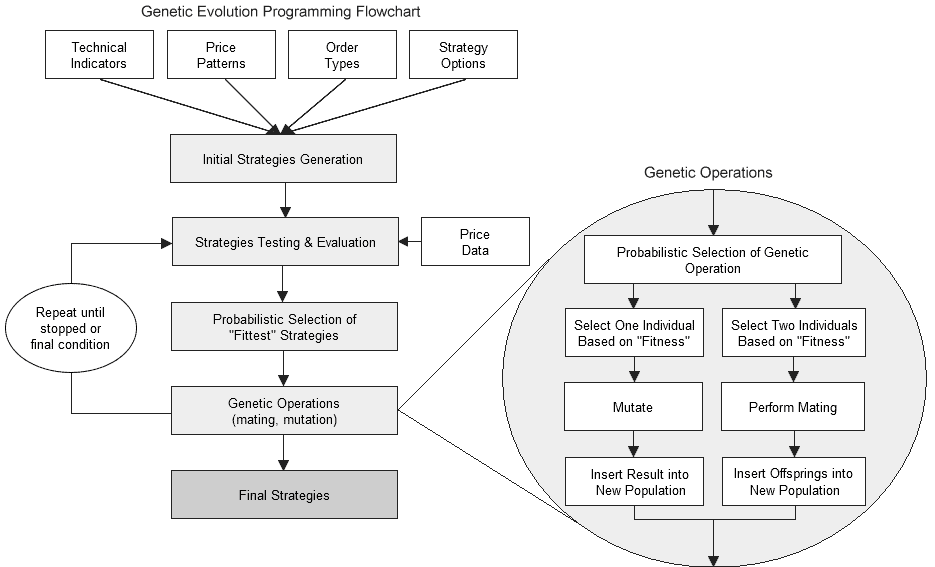
To enhance strategy quality, the Genetic Algorithm applies a methodology inspired by biological evolution. The process includes:
- Initial Population: A set of randomly generated strategies serves as the starting point.
- Évaluation: Each strategy is evaluated against selected performance metrics (e.g., profit factor, drawdown, Sharpe ratio).
- Selection and Reproduction: The best-performing strategies are selected and used to generate the next generation through crossover and mutation techniques.
- Iteration: This evolutionary cycle is repeated over several generations, progressively improving strategy performance.
The result is a set of strategies that are more likely to be profitable, robust, and aligned with user-defined criteria.
Supported Building Blocks
StrategyQuant X includes over 250 predefined building blocks, covering:
- Standard technical indicators (CCI, RSI, Stochastic, Momentum, etc.)
- Common order types (Market, Stop, Limit. Reverse)
- Advanced exit strategies (Trailing Stop, Move Stop Loss to Break Even, Partials,…)
Additionally, users can extend the platform by:
- Creating custom building blocks
- Developing and integrating custom technical indicators
If you would like to see a specific indicator or feature added to StrategyQuant X, please contact our support team.
Exemple de code de stratégie
Below is an example pseudo code of a strategy generated by StrategyQuant. You can see that strategy consists of entry orders, exit orders and trade management commands – such as trailing stop movements, etc.
Chaque stratégie générée par le programme peut être visualisée dans ce pseudo-code ou exportée sous forme d'Expert Advisor (EA) MetaTrader, de stratégie NinjaTrader NinjaScript C# ou d'EasyLanguage pour Tradestation/Multicharts.
====================================================================
== Entry conditions
====================================================================
LongEntryCondition = (Stoch(40, 1, 3) < 50)
ShortEntryCondition = (Stoch(40, 1, 3) > 50)

====================================================================
== Entry orders
====================================================================
-- Long entry

if LongEntryCondition is true {
    if No position is open then Buy at Ichimoku(6, 18, 38, Kijun-sen) + (0.4 * ATR(86)) Limit;
    Stop/Limit order expires after 34 bars.

    Stop Loss = 190 pips;
    Profit Target = (0.74 * ATR(87)) pips;

    // Move SL to BE (on close)
    Move Stop Loss to Entry price when in profit at least (77 * ATR(12)) pips;

    // Profit trailing (on close)
    Profit Trailing by 222 pips;

    // Stop trailing (on close)
    Move Stop to (Close(1) + (0.5) * BBWidthRatio(20, 2.0))) on bar close;
}

-- Short entry
if ShortEntryCondition is true {
    if No position is open then Sell at Ichimoku(6, 18, 38, Kijun-sen) + (-0.4 * ATR(86)) Limit;
    Stop/Limit order expires after 34 bars.

    Stop Loss = 190 pips;
    Profit Target = (0.74 * ATR(87)) pips;
}

====================================================================
== Exit orders
====================================================================
-- Long exit

if MarketPosition is Long {
    if (Bars Since Entry >= 33) {
        Close position at market;
    }
}
Cet article a-t-il été utile ? L'article était utile L'article n'était pas utile
Contenu des pages