


 Inglês
 Espanhol
 Francês
 Italiano
 Alemão
 Japonês
Ordem de Mercado Múltiplo
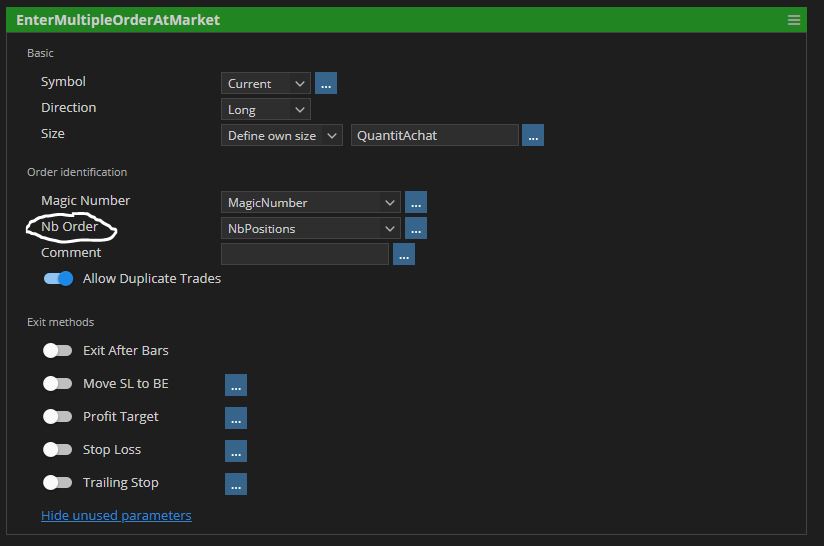
Aqui está um trecho de Ordens Múltiplas no Mercado.
Ele enviará vários pedidos ao mesmo tempo com um número mágico diferente.
Na captura, você pode selecionar o nb (número) de ordem e um número mágico.
Por exemplo, se você selecionar 3 como número de ordens e 1000 como número mágico, criará 3 ordens de mercado com o seguinte número mágico: 1000, 1001 e depois 1002...
(você pode criar uma grande quantidade de pedidos conforme sua necessidade)
Então você pode fechar parcialmente algumas das ordens do mercado em uma meta de lucro e depois fechar outras ordens em diferentes metas de lucro ou stop loss.
package SQ.Blocks.Order.Open;
import java.util.ArrayList;
import com.strategyquant.datalib.TradingException;
import com.strategyquant.datalib.UpdateEventTypes;
import com.strategyquant.lib.SQTime;
import com.strategyquant.lib.SQUtils;
import com.strategyquant.lib.SettingsMap;
import com.strategyquant.tradinglib.ATM;
import com.strategyquant.tradinglib.ATMExit;
import com.strategyquant.tradinglib.BlockDefinitionException;
import com.strategyquant.tradinglib.BuildingBlock;
import com.strategyquant.tradinglib.CategoryOrder;
import com.strategyquant.tradinglib.Editor;
import com.strategyquant.tradinglib.Editors;
import com.strategyquant.tradinglib.ExitMethod;
import com.strategyquant.tradinglib.ExitTypes;
import com.strategyquant.tradinglib.Help;
import com.strategyquant.tradinglib.IActionEventListener;
import com.strategyquant.tradinglib.IFormula;
import com.strategyquant.tradinglib.ILiveOrder;
import com.strategyquant.tradinglib.Order;
import com.strategyquant.tradinglib.OrderCloseTypes;
import com.strategyquant.tradinglib.OrderTypes;
import com.strategyquant.tradinglib.Parameter;
import com.strategyquant.tradinglib.Required;
import com.strategyquant.tradinglib.ReturnTypes;
import com.strategyquant.tradinglib.SortOrder;
import com.strategyquant.tradinglib.StrategyBase;
import com.strategyquant.tradinglib.atm.exits.None;
import com.strategyquant.tradinglib.atm.exits.TrailingStop;
import com.strategyquant.tradinglib.simulator.Engines;
import SQ.ExitMethods.StopLoss;
import SQ.Functions.OrderFunctions;
import SQ.Internal.ActionBlock;
import SQ.Internal.MMFormulaBlock;
// Modified in France by Emmanuel Evrard for the StrategyQuantX Community :)
@BuildingBlock(name="(MMKT) Enter Multiple Order at market", display="EnterMultipleOrderAtMarket", returnType=ReturnTypes.Order)
@Help("Opens Multiple order at current market price")
@SortOrder(400)
@CategoryOrder(100)
public class EnterAtMarketMultiOrder extends ActionBlock
{
private static final int MaxDistanceFromMarketHash = "MaxDistanceFromMarket.MaxDistanceFromMarket".hashCode();
private static final int MaxDistanceFromMarketPctHash = "MaxDistanceFromMarket.MaxDistancePct".hashCode();
// Basic parameters
@Parameter(defaultValue="Any", category="Basic", showIfDefault=false)
@Editor(type=Editors.SelectionSymbolsWithAny)
public String Symbol;
@Parameter(defaultValue="1", category="Basic")
@Editor(type=Editors.Selection, values="Long=1,Short=-1")
public int Direction;
@Parameter(category="Basic")
@Editor(type=Editors.Formula, formulaName="Size")
@Required
public IFormula Size;
// Other parameters
@Parameter(defaultValue="MagicNumber", category="Order identification", showIfDefault=false)
@Help("Magic number is used to identify the first trade, it should be unique for every trade you open.")
@Editor(type=Editors.SelectionVariables)
public int MagicNumber;
@Parameter(defaultValue="Number Of Order", category="Order identification", showIfDefault=false)
@Help("Number Of Order is used to set the quantity of order, Their MagicNumbers are successives to the above MagicNumber")
@Editor(type=Editors.SelectionVariables)
public int NbOrder;
@Parameter(defaultValue="", category="Order identification", showIfDefault=false)
public String Comment;
@Parameter(defaultValue="false", category="Order identification", showIfDefault=false)
@Help("If set to true, it will allow to place multiple trades with the same Magic Number")
public boolean AllowDuplicateTrades;
public ExitMethod[] ExitMethods;
//------------------------------------------------------------------------
//------------------------------------------------------------------------
//------------------------------------------------------------------------
@Override
public void OnAction() throws TradingException
{
if((!AllowDuplicateTrades || !engineSupportsDuplicateTrades()) && checkLiveOrderExists(0, true) != null)
{
// market is not flat and duplicate trades are not allowed
return;
}
// open trade
byte orderType = (Direction > 0 ? OrderTypes.Buy : OrderTypes.Sell);
double sl = computeSL(orderType, (Direction > 0 ? Strategy.MarketData.Chart(Symbol).Ask() : Strategy.MarketData.Chart(Symbol).Bid()));
double size = computeSize(orderType, 0, sl);
ATM atm = Strategy.getATM();
if(atm != null && atm.isApplicable(Strategy, size, sl, orderType))
{
double pt = computePT(orderType, (Direction > 0 ? Strategy.MarketData.Chart(Symbol).Ask() : Strategy.MarketData.Chart(Symbol).Bid()));
int MagicNumber1 = MagicNumber;
for(int i = 0; i < NbOrder; i++)
{
MagicNumber = MagicNumber1 + i ;
openATMOrder(atm, -1, size, sl, pt, orderType, 0);
}
}
else
{
int MagicNumber1 = MagicNumber;
for(int i = 0; i < NbOrder; i++)
{
MagicNumber = MagicNumber1 + i ;
openNormalOrder(-1, size, sl, orderType, 0);
}
}
}
//------------------------------------------------------------------------
protected void openATMOrder(ATM atm, double openPrice, double fullSize, double sl, double pt, byte orderType, int barsValid) throws TradingException
{
ExitMethod slExit = getStopLossExit();
double sizeSoFar = 0;
if(Strategy.getEngine() == Engines.MetaTrader4 || Strategy.getEngine() == Engines.MetaTrader5Hedged) {
for(int i=0; i<atm.getExitsCount(); i++) {
ATMExit atmExit = tryCloneATMExit(atm.getExit(i));
boolean isLastExit = (i == atm.getExitsCount()-1);
double size = atmExit.computeSize(fullSize, sizeSoFar, isLastExit);
if(size > 0) {
ILiveOrder order = Strategy.Trader.Open(orderType, Symbol, openPrice)
.setSize(size)
.setMagicNumber(MagicNumber)
.setComment(Comment)
.Send();
sizeSoFar += order.getSize();
if(order.isSuccessful()) {
handleBarsValid(order, barsValid);
// add standard SL
if(slExit != null && !order.isClosedOrder()) {
slExit.setForOrder(order, Strategy);
}
// add ATM exit
atmExit.setForOrder(order, Strategy, sl, pt);
}
}
}
}
else {
ILiveOrder order = Strategy.Trader.Open(orderType, Symbol, openPrice)
.setSize(fullSize)
.setMagicNumber(MagicNumber)
.setComment(Comment)
.Send();
if(order.isSuccessful()) {
handleBarsValid(order, barsValid);
// add standard SL
if(slExit != null && !order.isClosedOrder()) {
slExit.setForOrder(order, Strategy);
}
for(byte i=0; i<atm.getExitsCount(); i++) {
ATMExit atmExit = tryCloneATMExit(atm.getExit(i));
boolean isLastExit = (i == atm.getExitsCount() - 1);
double size = atmExit.computeSize(fullSize, sizeSoFar, isLastExit);
if(size > 0) {
sizeSoFar += Strategy.getEngine() == Engines.MetaTrader5Netted ? openNewATMNettingOrder(order, atmExit, size, sl, pt, i) : openNewTSATMOrder(order, atmExit, size, sl, pt, i);
}
}
}
}
}
//------------------------------------------------------------------------
private double openNewTSATMOrder(ILiveOrder mainOrder, ATMExit atmExit, double size, double sl, double pt, byte exitIndex) throws TradingException {
mainOrder.registerEvent(UpdateEventTypes.BarOpen, new IActionEventListener() {
private ILiveOrder exitOrder = null;
private double actualSL = -1, actualPT = -1;
private double lastTS = -1;
private boolean filled = false;
@Override
public void OnActionEvent(StrategyBase strategy) throws TradingException {
if(mainOrder.isClosedOrder()) {
if(exitOrder != null) {
exitOrder.Close(OrderCloseTypes.Deleted);
exitOrder = null;
}
return;
}
if(!mainOrder.isMarketOrder()) return;
//SL and PT must be calculated when order is filled. Otherwise it may use old indicator values (TradeStation fills on next bar)
actualSL = computeSL(mainOrder.getOrderType(), mainOrder.getOpenPrice());
actualPT = computePT(mainOrder.getOrderType(), mainOrder.getOpenPrice());
if(atmExit.exitLevel instanceof None) {
None noneExit = (None) atmExit.exitLevel;
if(noneExit.checkExitAfterBars(mainOrder)) {
noneExit.deactivate();
Strategy.Trader.Open(mainOrder.isLong() ? OrderTypes.Sell : OrderTypes.Buy, mainOrder.getSymbol(), 0)
.setSize(size)
.setMagicNumber(MagicNumber)
.setComment(Comment)
.setExitIndex(exitIndex)
.Send();
}
}
else if(atmExit.exitLevel instanceof TrailingStop) {
if(filled) return;
double newTrailingPrice = SQUtils.fixPrice(Strategy.getInstrumentInfo().tickStep, atmExit.exitLevel.getNettingPrice(Strategy, mainOrder, actualSL, actualPT));
if(mainOrder.isLong()) {
if(newTrailingPrice > mainOrder.getOpenPrice() && newTrailingPrice > actualSL && newTrailingPrice > lastTS) {
//move trailing exit closer to current price
lastTS = newTrailingPrice;
}
}
else {
if(newTrailingPrice < mainOrder.getOpenPrice() && newTrailingPrice < actualSL && (newTrailingPrice < lastTS || lastTS < 0)) {
//move trailing exit closer to current price
lastTS = newTrailingPrice;
}
}
if(exitOrder != null) {
if(exitWasFilled(exitOrder)) { //Trailing stop has been hit
filled = true;
return;
}
else {
exitOrder.Close(OrderCloseTypes.Replaced);
}
}
if(lastTS > 0) {
exitOrder = Strategy.Trader.Open(Direction > 0 ? OrderTypes.SellStop : OrderTypes.BuyStop, Symbol, lastTS)
.setSize(size)
.setMagicNumber(MagicNumber)
.setComment(Comment)
.setExitIndex(exitIndex)
.Send();
exitOrder.registerEvent(UpdateEventTypes.OrderFilled, new IActionEventListener() {
@Override
public void OnActionEvent(StrategyBase Strategy) throws TradingException {
if(exitWasFilled(exitOrder)) {
filled = true;
}
}
});
}
}
else {
if(filled) return;
double exitOpenPrice = SQUtils.fixPrice(Strategy.getInstrumentInfo().tickStep, atmExit.exitLevel.getNettingPrice(Strategy, mainOrder, actualSL, actualPT));
if(exitOpenPrice <= 0) {
return;
}
if(exitOrder != null) {
if(exitWasFilled(exitOrder)) return;
else {
exitOrder.Close(OrderCloseTypes.Deleted);
exitOrder = null;
}
}
exitOrder = Strategy.Trader.Open(Direction > 0 ? OrderTypes.SellLimit : OrderTypes.BuyLimit, Symbol, exitOpenPrice)
.setSize(size)
.setMagicNumber(MagicNumber)
.setComment(Comment)
.setExitIndex(exitIndex)
.Send();
if(exitOrder.isSuccessful()) {
exitOrder.registerEvent(UpdateEventTypes.BarOpen, new IActionEventListener() {
@Override
public void OnActionEvent(StrategyBase strategy) throws TradingException {
boolean mainOrderExists = false;
for(int i=Strategy.Trader.getOpenOrdersCount(false) - 1; i >= 0; i--) {
ILiveOrder order = Strategy.Trader.getOpenOrder(i, false);
if(order.getOrderId() == mainOrder.getOrderId()) {
mainOrderExists = true;
}
}
if(!mainOrderExists) {
exitOrder.Close(OrderCloseTypes.Deleted);
}
}
});
exitOrder.registerEvent(UpdateEventTypes.OrderFilled, new IActionEventListener() {
@Override
public void OnActionEvent(StrategyBase Strategy) throws TradingException {
if(exitWasFilled(exitOrder)) {
filled = true;
}
}
});
}
}
}
});
return size;
}
//------------------------------------------------------------------------
private double openNewATMNettingOrder(ILiveOrder mainOrder, ATMExit atmExit, double size, double sl, double pt, byte exitIndex) throws TradingException {
// for None attach a BarOpen event listener and close after number of bars set
if(atmExit.exitLevel instanceof None) {
mainOrder.registerEvent(UpdateEventTypes.BarOpen, new IActionEventListener() {
@Override
public void OnActionEvent(StrategyBase strategy) throws TradingException {
if(mainOrder.isClosedOrder() || !mainOrder.isMarketOrder()) return;
None noneExit = (None) atmExit.exitLevel;
if(noneExit.checkExitAfterBars(mainOrder)) {
noneExit.deactivate();
ILiveOrder exitOrder = Strategy.Trader.Open(mainOrder.isLong() ? OrderTypes.Sell : OrderTypes.Buy, mainOrder.getSymbol(), 0)
.setSize(size)
.setMagicNumber(MagicNumber)
.setComment(Comment)
.setExitIndex(exitIndex)
.Send();
}
}
});
return size;
}
else if(atmExit.exitLevel instanceof TrailingStop) {
mainOrder.registerEvent(UpdateEventTypes.BarOpen, new IActionEventListener() {
private ILiveOrder exitOrder = null;
private double lastTS = -1;
private boolean filled = false;
@Override
public void OnActionEvent(StrategyBase strategy) throws TradingException {
if(filled) return;
if(mainOrder.isClosedOrder()) {
if(exitOrder != null) {
exitOrder.Close(OrderCloseTypes.Deleted);
exitOrder = null;
}
return;
}
if(mainOrder.isMarketOrder()) {
double newTrailingPrice = SQUtils.fixPrice(Strategy.getInstrumentInfo().tickStep, atmExit.exitLevel.getNettingPrice(Strategy, mainOrder, mainOrder.getSL(), mainOrder.getPT()));
double prevTS = lastTS;
if(mainOrder.isLong()) {
if(newTrailingPrice > mainOrder.getOpenPrice() && newTrailingPrice > mainOrder.getSL() && newTrailingPrice > lastTS) {
//move trailing exit closer to current price
lastTS = newTrailingPrice;
}
}
else {
if(newTrailingPrice < mainOrder.getOpenPrice() && newTrailingPrice < mainOrder.getSL() && (newTrailingPrice < lastTS || lastTS < 0)) {
//move trailing exit closer to current price
lastTS = newTrailingPrice;
}
}
if(prevTS != lastTS && lastTS > 0) {
if(exitOrder != null) {
exitOrder.Close(OrderCloseTypes.Replaced);
}
exitOrder = Strategy.Trader.Open(Direction > 0 ? OrderTypes.SellStop : OrderTypes.BuyStop, Symbol, lastTS)
.setSize(size)
.setMagicNumber(MagicNumber)
.setComment(Comment)
.setExitIndex(exitIndex)
.Send();
exitOrder.registerEvent(UpdateEventTypes.OrderFilled, new IActionEventListener() {
@Override
public void OnActionEvent(StrategyBase Strategy) throws TradingException {
if(exitWasFilled(exitOrder)) {
filled = true;
}
}
});
}
}
}
});
return size;
}
// for other types create limit orders
double exitOpenPrice = SQUtils.fixPrice(Strategy.getInstrumentInfo().tickStep, atmExit.exitLevel.getNettingPrice(Strategy, mainOrder, sl, pt));
if(exitOpenPrice <= 0) {
return 0;
}
ILiveOrder exitOrder = Strategy.Trader.Open(Direction > 0 ? OrderTypes.SellLimit : OrderTypes.BuyLimit, Symbol, exitOpenPrice)
.setSize(size)
.setMagicNumber(MagicNumber)
.setComment(Comment)
.setExitIndex(exitIndex)
.Send();
if(exitOrder.isSuccessful()) {
exitOrder.registerEvent(UpdateEventTypes.BarOpen, new IActionEventListener() {
@Override
public void OnActionEvent(StrategyBase strategy) throws TradingException {
boolean mainOrderExists = false;
for(int i=Strategy.Trader.getOpenOrdersCount(false) - 1; i >= 0; i--) {
ILiveOrder order = Strategy.Trader.getOpenOrder(i, false);
if(order.getOrderId() == mainOrder.getOrderId()) {
mainOrderExists = true;
}
}
if(!mainOrderExists) {
exitOrder.Close(OrderCloseTypes.Deleted);
}
}
});
return size;
}
else return 0;
}
//------------------------------------------------------------------------
private boolean exitWasFilled(ILiveOrder exitOrder) {
return exitOrder.isMarketOrder() && exitOrder.getCloseTime() > 0;
}
//------------------------------------------------------------------------
protected void openNormalOrder(double openPrice, double size, double sl, byte orderType, int barsValid) throws TradingException {
ILiveOrder order = Strategy.Trader.Open(orderType, Symbol, openPrice)
.setSize(size)
.setMagicNumber(MagicNumber)
.setComment(Comment)
.Send();
if(order.isSuccessful()) {
handleBarsValid(order, barsValid);
for(ExitMethod exitMethod : ExitMethods) {
if(!order.isClosedOrder()) {
if(AllowDuplicateTrades) {
//we have to clone the exit method, otherwise it makes problems when strategy has duplicate trades enabled (problem example: Trailing Stop is set only for the first order)
try {
ExitMethod exitMethodCloned = (ExitMethod) exitMethod.clone(true, Strategy);
exitMethodCloned.setForOrder(order, Strategy);
}
catch (BlockDefinitionException e) {
Log.error("Cannot clone exit method '" + exitMethod.getClass().getName() + "' for order #" + order.getOrderId(), e);
}
}
else {
exitMethod.setForOrder(order, Strategy);
}
}
}
}
}
//------------------------------------------------------------------------
protected void handleBarsValid(ILiveOrder order, int barsValid) throws TradingException {
if(order.isClosedOrder() || order.isMarketOrder()) return;
// order is placed, now handle order validity
if(barsValid != 0) {
order.registerEvent(UpdateEventTypes.BarOpen, new IActionEventListener() {
@Override
public void OnActionEvent(StrategyBase strategy) throws TradingException {
checkBarsValid(order, barsValid);
}
});
}
}
//------------------------------------------------------------------------
protected void checkBarsValid(ILiveOrder order, int barsValid) throws TradingException {
if(order.isClosedOrder()) return;
if(order.isPendingOrder() && order.getBarsInTrade() >= barsValid) {
order.Close(OrderCloseTypes.Expired);
}
}
//------------------------------------------------------------------------
protected double computeSL(byte orderType, double orderPrice) throws TradingException {
ExitMethod slExit = getStopLossExit();
if(slExit == null) {
// no SL
return Order.NOT_DEFINED;
}
return SQUtils.fixPrice(Strategy.getInstrumentInfo().tickStep, slExit.computeValue(orderType, Strategy, Symbol, orderPrice));
}
//------------------------------------------------------------------------
protected double computePT(byte orderType, double orderPrice) throws TradingException {
ExitMethod ptExit = getProfitTargetExit();
if(ptExit == null) {
// no PT
return Order.NOT_DEFINED;
}
double tickStep = Strategy.getInstrumentInfo().tickStep;
return SQUtils.fixPrice(tickStep, ptExit.computeValue(orderType, Strategy, Symbol, orderPrice));
}
//------------------------------------------------------------------------
private ExitMethod getStopLossExit() {
ExitMethod slExit = null;
for(ExitMethod exitMethod : ExitMethods) {
if(exitMethod.getExitType() == ExitTypes.StopLoss) {
slExit = exitMethod;
break;
}
}
return slExit;
}
//------------------------------------------------------------------------
private ExitMethod getProfitTargetExit() {
ExitMethod ptExit = null;
for(ExitMethod exitMethod : ExitMethods) {
if(exitMethod.getExitType() == ExitTypes.ProfitTarget) {
ptExit = exitMethod;
break;
}
}
return ptExit;
}
//------------------------------------------------------------------------
protected double computeSize(byte orderType, double price, double sl) throws TradingException {
MMFormulaBlock sizeFormula = (MMFormulaBlock) Size;
return sizeFormula.computeSize(Strategy, Symbol, orderType, price, sl);
}
//------------------------------------------------------------------------
protected ILiveOrder checkLiveOrderExists(int direction, boolean includeClosingOrders) {
int count = Strategy.Trader.getOpenOrdersCount(includeClosingOrders) - 1;
for(int i=count; i >= 0; i--) {
ILiveOrder order = Strategy.Trader.getOpenOrder(i, includeClosingOrders);
if(OrderFunctions.identify(order, Strategy, Symbol, direction, MagicNumber, Comment) && order.isMarketOrder()) {
return order;
}
}
return null;
}
//------------------------------------------------------------------------
/**
* this method is called only in Tradestation engine, to handle exits (SL, PT, etc.) as same as they are handled in TS.
* @throws TradingException
*/
public void OnApplyExits() throws TradingException {
ArrayList<ILiveOrder> orders = getOpenOrders(Direction);
ATM atm = Strategy.getATM();
boolean slPlaced = false;
if(orders != null) {
for(int i=0; i<orders.size(); i++) {
ILiveOrder order = orders.get(i);
boolean atmUsed = atm != null && atm.isApplicable(Strategy, order.getSize(), order.getSL(), order.getOrderType());
for(ExitMethod exitMethod : ExitMethods) {
if(!atmUsed || exitMethod instanceof StopLoss) {
if(exitMethod.setExit(order, Strategy)) {
slPlaced = true;
}
}
}
if(!slPlaced && order.getSL() != Order.NOT_DEFINED) {
// we have to set SL from order - handling if there is no SL, only for Trailing stop or Move2BE
int direction = order.isLong() ? -1 : 1;
byte orderType = (direction > 0 ? OrderTypes.BuyToCoverStop : OrderTypes.SellToCoverStop);
ILiveOrder slOrder = Strategy.Trader.Open(orderType, order.getSymbol(), order.getSL())
.setComment("SL")
.setMagicNumber(order.getMagicNumber())
.Send();
}
}
}
}
//------------------------------------------------------------------------
private ArrayList<ILiveOrder> getOpenOrders(int direction) {
ArrayList<ILiveOrder> orders = null;
for(int i=0; i<Strategy.Trader.getOpenOrdersCount(false); i++) {
ILiveOrder order = Strategy.Trader.getOpenOrder(i, false);
if(order.isPendingOrder()) {
continue;
}
if(OrderFunctions.identify(order, Strategy, Symbol, direction, MagicNumber, Comment) && order.isMarketOrder()) {
if(orders == null) {
orders = new ArrayList<ILiveOrder>();
}
orders.add(order);
}
}
return orders;
}
//------------------------------------------------------------------------
protected boolean engineSupportsDuplicateTrades() {
return Strategy.Trader.supportsDuplicateTrades();
}
//------------------------------------------------------------------------
private ATMExit tryCloneATMExit(ATMExit exit) throws TradingException {
ATMExit clone = exit.clone();
if(clone == null) {
throw new TradingException("Unable to create ATMExit object");
}
return clone;
}
//------------------------------------------------------------------------
protected boolean checkOpenPriceWithinRange(double openPrice) {
try {
SettingsMap settings = Strategy.getSettings();
if(settings.containsKey(MaxDistanceFromMarketHash) && settings.containsKey(MaxDistanceFromMarketPctHash) && ((boolean) settings.get(MaxDistanceFromMarketHash))) {
double maxPctDistance = SQUtils.round2((double) settings.get(MaxDistanceFromMarketPctHash));
double currentPrice = Direction > 0 ? Strategy.MarketData.Chart(Symbol).Ask() : Strategy.MarketData.Chart(Symbol).Bid();
double distancePct = SQUtils.round2(Math.abs(currentPrice - openPrice) / currentPrice * 100);
if(distancePct > maxPctDistance) {
Log.debug("Order skipped - too far from market. Open price: {}, Market price: {}, Max distance: {}%", openPrice, currentPrice, maxPctDistance);
return false;
}
}
}
catch(Throwable t) {
Log.error("Error while checking open price max distance", t);
}
return true;
}
}

Bom trabalho!
Obrigado Bentra!
Olá,
Você poderia me explicar como posso adicionar esse código à estratégia existente?
Isso pode ser feito para ordem de limite, por exemplo, enteratlimitmultiorder