


 Spanish
 Portuguese
 French
 Italian
 German
 Japanese
The 2-Step Challenge Analyzer for FTMO: Know If Your Strategy Will Pass Before You Pay
Page contents
The 2-Step Challenge Analyzer for FTMO: Know If Your Strategy Will Pass Before You Pay
If you build strategies in StrategyQuantX and you’ve ever stared at a great-looking backtest wondering “but would this actually pass a prop challenge?” — this plugin was built for you.
The 2-Step Challenge Analyzer is a free Results-tab plugin for StrategyQuantX. It takes any strategy or portfolio and runs it through a complete two-phase prop-firm evaluation — the real rules, the real intraday risk — then tells you whether it would have passed, how often it would pass if you started on a different day, and which account size is actually worth buying.
It’s a dress rehearsal for your challenge, run thousands of times, before a single euro leaves your account.
What it does
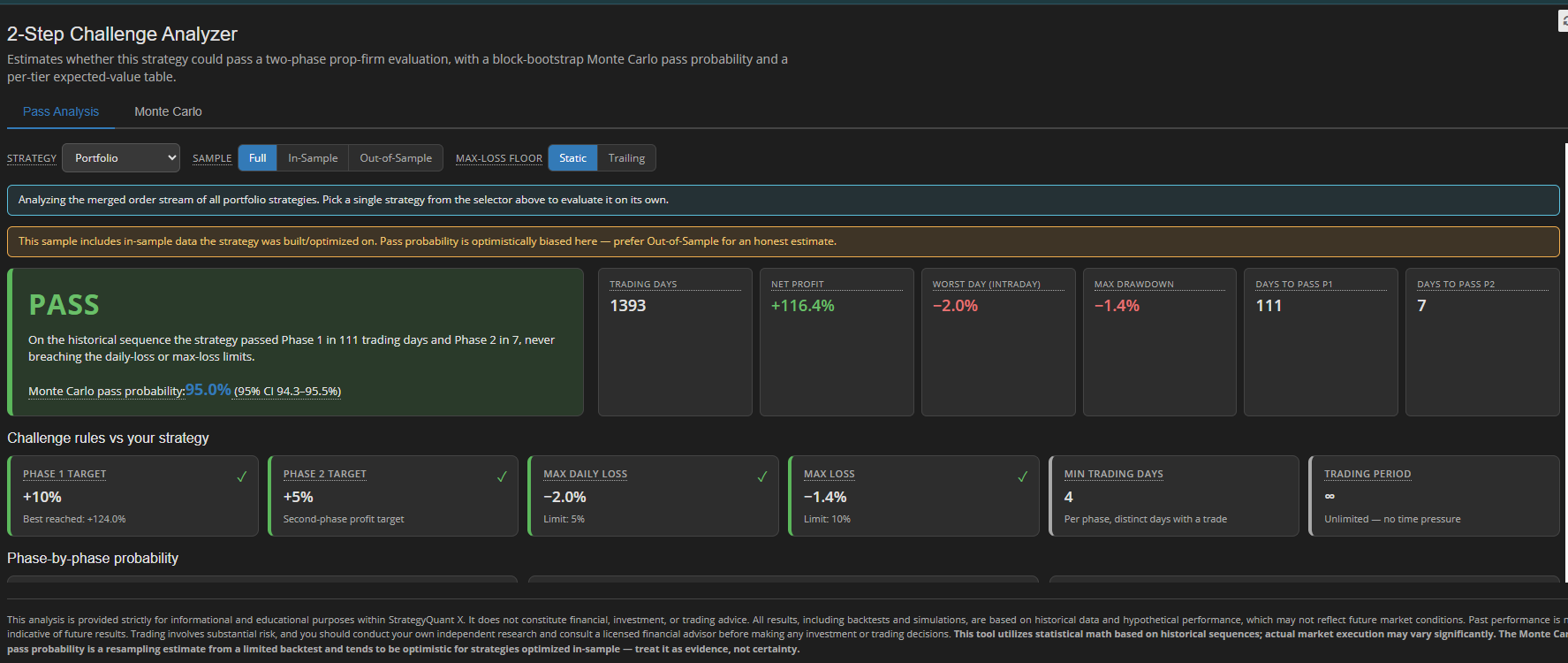
Most traders judge a challenge by eyeballing the equity curve and hoping. This plugin does three concrete things instead:
- Replays the real rule set — profit targets, daily-loss limit, overall max-loss limit, minimum trading days — checked against worst-case intraday equity (using each trade’s Maximum Adverse Excursion), not just the closing balance. A day that ends green but dipped hard mid-session can still bust a limit, and this catches it.
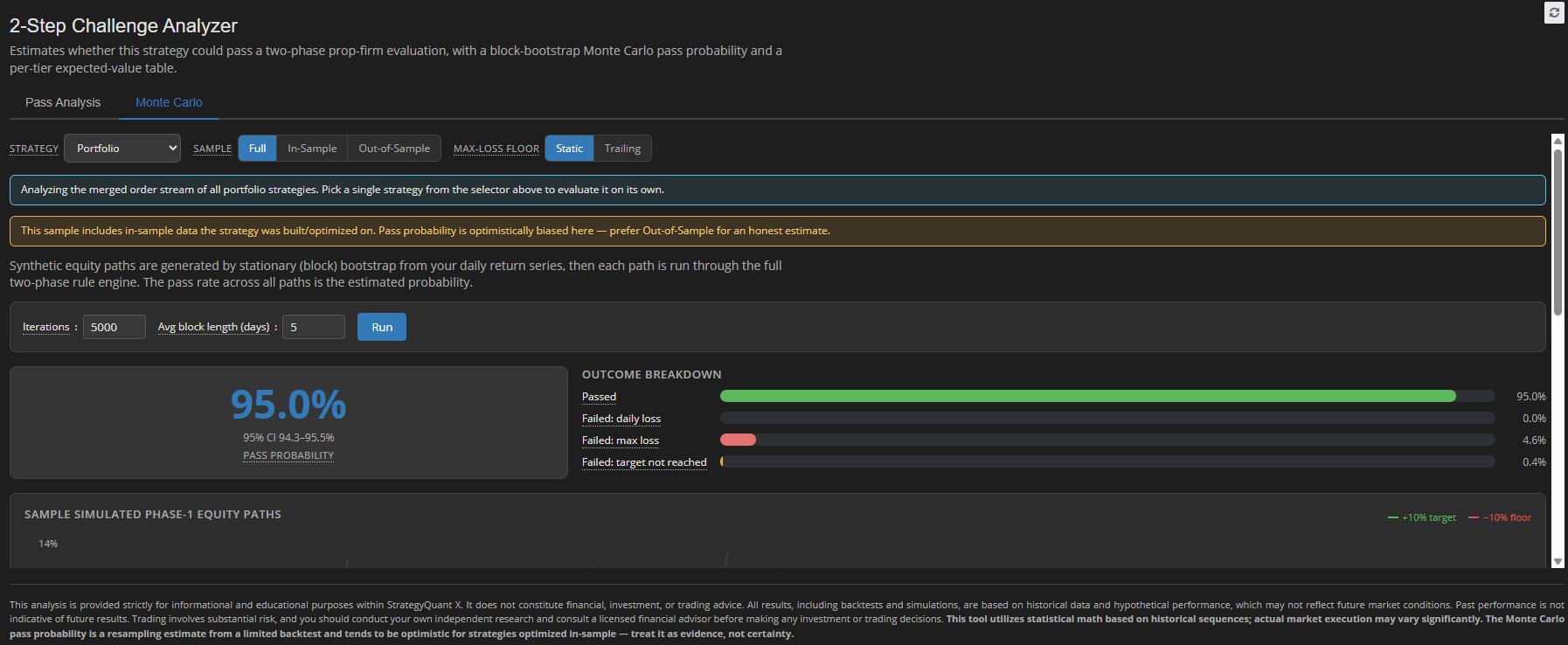
- Estimates your true pass probability with a Monte Carlo simulation that reshuffles your daily returns thousands of times while preserving losing streaks, then reports the share of runs that cleared both phases — with a 95% confidence interval.
- Ranks the account tiers by expected value, so you can see which fee/reward combination is mathematically worth it.
The rules it models out of the box:
| Rule | Phase 1 | Phase 2 |
|---|---|---|
| Profit target | +10% | +5% |
| Max daily loss | −5% | −5% |
| Max overall loss | −10% | −10% |
| Minimum trading days | 4 | 4 |
| Time limit | None | None |
(If your firm uses different numbers, they live in a single constant at the top of the file and are easy to change.)
How to install it
It’s a drop-in folder — no build step, no dependencies, no internet required.
- Copy the plugin folder into your SQX installation: <SQX-install>/user/extend/ResultsPlugins/2-Step Challenge Analyzer/Make sure the folder contains index.html, the locales/ folder, and vue.global.prod.js
- Restart StrategyQuantX — or just click the reload icon in the Results tab to pick it up without a full restart.
- Open it. Run any backtest, go to the Results tab, and select 2-Step Challenge Analyzer from the tab strip.
You’ll need SQX Pro (up to 3 custom plugins) or Ultimate (unlimited). Starter doesn’t support custom plugins.
That’s it. The plugin reads your strategy automatically — nothing to configure, nothing to export.
How to use it, step by step
1. Pick what you’re analyzing.
If you’re on a portfolio, a Strategy dropdown lets you analyze the merged portfolio or drill into any single strategy on its own — perfect for spotting which component is dragging the basket down.
2. Switch to Out-of-Sample.
The Sample toggle (Full / In-Sample / Out-of-Sample) matters more than anything. In-sample data is what your strategy was optimized on, so it always flatters you. For an honest estimate, use Out-of-Sample — the plugin even warns you when you’re not.
3. Match your firm’s floor type.
Some firms use a static max-loss floor (fixed at −10% from the start); others use a trailing floor that ratchets up as you make new highs, punishing you for giving back profits. Pick whichever your firm actually uses — trailing is stricter.
4. Read the verdict, then the probability.
The big card shows PASS or FAIL on the historical run, with the exact reason if it failed. But the number that really matters sits just below it: the Monte Carlo pass probability. Above ~60% is a solid candidate; under ~40% means your backtest PASS was mostly luck.
5. Open the Monte Carlo tab for the full picture.
Here you get:
- The pass probability with its confidence interval (a wide band = not enough history to trust it).
- An outcome breakdown showing how failing runs died — daily loss, max loss, or simply never reaching the target. This points straight at the fix.
- Median and average days to pass each phase, plus a histogram of how long passing attempts took — with median and average marker lines — so you know not just if you’ll pass, but roughly when.
6. Plug in your real numbers.
The Expected Value table is fully editable. Enter your firm’s actual fee and average payout per tier, and it computes EV and ROI for each, flagging the best-value and best-EV options.
Every metric in the plugin has a hover tooltip with a plain-language definition and a worked example, so you’re never left guessing what a number means.
How to read the results like a pro
- High historical PASS but low Monte Carlo probability? Your backtest got a lucky ordering. Trust the probability, not the verdict.
- Failing mostly by daily loss? Position sizing is too aggressive on bad days — cut risk or cap concurrent trades.
- Failing by max loss, especially on trailing? You’re a “give-back” strategy that builds profit then surrenders it. Trailing floors are merciless about this.
- Failing by “target not reached”? No risk tweak will help — the strategy simply isn’t profitable enough.
- Average days-to-pass much higher than the median? Expect occasional long grinds even when you do pass. Plan your patience — and your subscription costs — accordingly.
A word of honesty
This is a statistical tool, not a crystal ball. Closed-trade backtests can only approximate true intraday execution, in-sample results flatter your strategy, and even a passed challenge can fizzle if the funded account later fails. Treat the pass probability as strong evidence, not a guarantee — and always validate on out-of-sample data. (The plugin carries a full disclaimer at the bottom for exactly this reason.)
The bottom line
Buying a prop challenge on a hunch is expensive. The 2-Step Challenge Analyzer turns that hunch into numbers you can defend: a probability, a confidence interval, a realistic time-to-pass, and a clear answer to “which account tier is worth my money?”
Install it, point it at your best strategies, and run it before your next purchase. It might save you a few failed challenges — and it’ll definitely make you a more honest judge of your own edge.
