


 Inglese
 Spagnolo
 Portoghese
 Francese
 Tedesco
 Giapponese
Documentazione e guide per l'utente
Imparate le basi o perfezionate le vostre abilità con le esercitazioni pensate per ispirarvi.
Ultimo aggiornamento il 23 aprile 2026 a cura di Kornel Mazur
Cross-Checks – Robust Testing – Overview
Contenuto della pagina
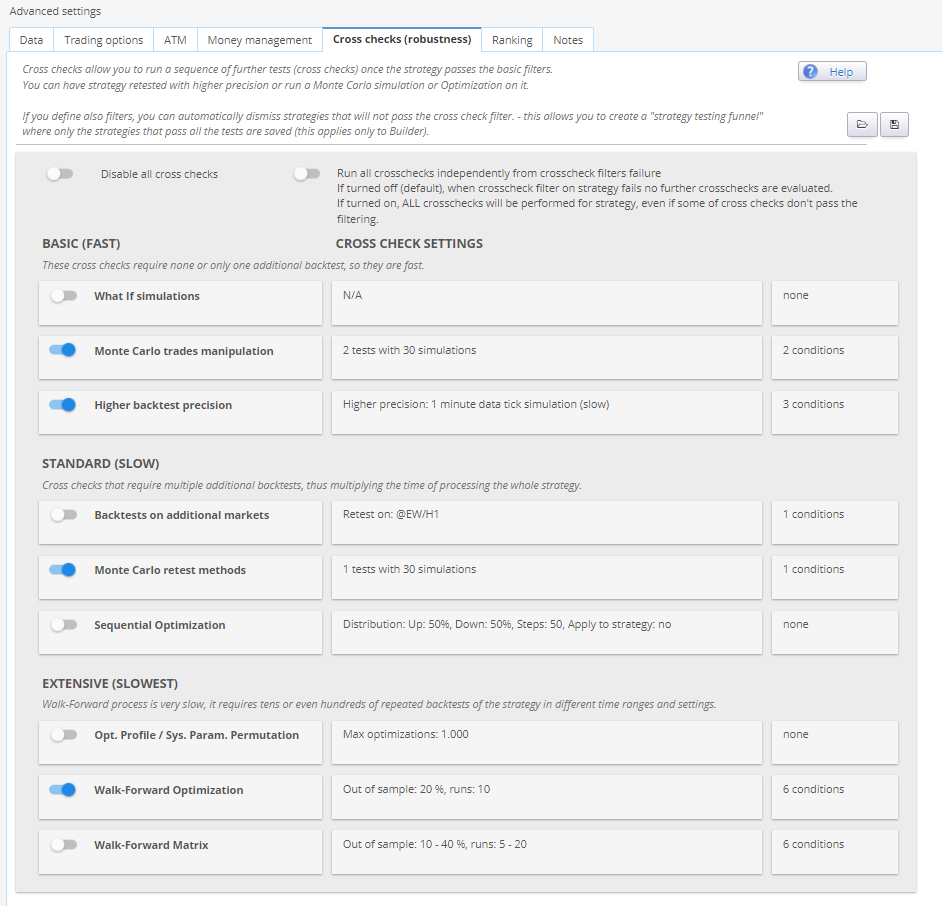
Cross-Checks – Automated Strategy Robustness Tests
A key challenge in algorithmic strategy development is overfitting (also known as curve-fitting), where a strategy is too closely tailored to historical data and fails to generalize to future, unseen market conditions. Cross-checks in StrategyQuant X are designed to address this challenge by applying automated robustness testing.
What is Robustness?
Robustezza refers to a strategy's ability to perform consistently across varying market conditions and data sets. A robust strategy should:
- Perform well on unseen (Out of Sample) data, assuming market behavior remains consistent.
- Be tolerant to minor variations in input parameters (e.g., indicator periods, trade entry/exit settings).
- Handle market anomalies, such as changes in spread, slippage, or missing trades, without significant performance degradation.
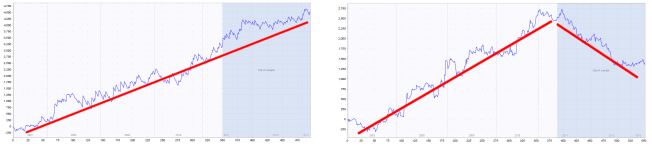
A basic robustness validation is testing strategy performance on Out of Sample data, especially after genetic evolution, which is performed only on the In Sample portion.
Why Use Cross-Checks?
Cross-checks help eliminate overfitted strategies by simulating alternate market conditions, modifying input variables, or retesting under different assumptions. They are applied after a strategy passes its initial generation and filtering phase.
Cross-checks can include:
- Precision retesting
- What If Simulations
- Simulazioni Monte Carlo
- Multi-market retesting
- Walk-Forward Analysis
- Matrice di avanzamento
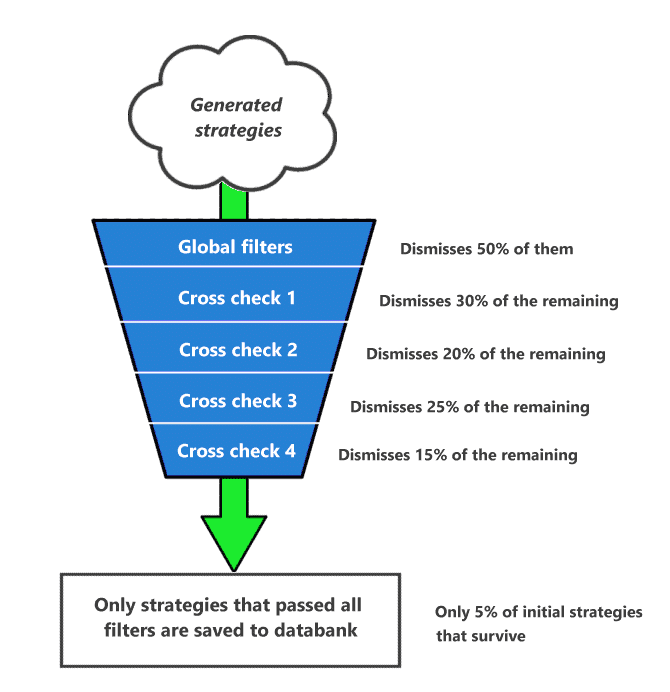
Strategies that fail a cross-check can be automatically excluded, allowing only robust candidates to proceed through the development funnel.
How Cross-Checks Work
Cross-checks can be used during both costruzione della strategia e post-analysis in the Retester. Within a build process, you can configure multiple cross-checks, arranged in order of increasing complexity. If a strategy fails at any stage, it is immediately discarded, and no further checks are performed on it.
Cross-check types are typically categorized by complexity and computational cost:
- Basi
- Standard
- Extensive
Important Note: Cross-checks can significantly increase processing time. A strategy generated in 0.2 seconds might require 10–200 seconds when subjected to cross-checks, depending on the complexity and number of simulations.
Example Usage: Robustness Filtering Funnel
Below is an example of a multi-layer cross-check process used to ensure strategy reliability:
- Initial Strategy Generation
- Strategy is generated and backtested with basic precision settings.
- Global Filtering
- Strategy is discarded if it fails core metrics (e.g., Net Profit < $1,000 or insufficient trade count).
- Cross-Check: Retest with Higher Precision
- Retesting at minute or real-tick precision to validate initial results.
- Cross-Check: Monte Carlo – Trade Manipulation
- Simulates alternate equity curves by rearranging or modifying trades to detect randomness.
- Cross-Check: Retest on Additional Markets
- Verifies strategy profitability on different symbols or timeframes.
- Optional Cross-Check: Monte Carlo – Retest Methods
- Conducts hundreds of independent backtests with minor variations (e.g., changes in slippage, spreads, or indicator parameters).
- If 100 simulations are run, each taking 0.2 seconds, this step alone may require 20 seconds per strategy.
- Final Outcome
- Only strategies that pass all selected cross-checks are saved to the Banca dati.
This layered approach helps ensure strategies are not only profitable under test conditions but also statistically reliable and resilient.
Additional Notes
- Cross-checks are not mandatory during the build phase. You can choose to apply them later in the Ritestatore, especially for time-intensive evaluations.
- Cross-check filters and thresholds can be fully customized based on your performance criteria and computational capacity.
Questo articolo è stato utile? L'articolo è stato utile L'articolo non è stato utile
Contenuto della pagina